Showing posts with label new orleans. Show all posts

Tuesday, February 5, 2013

Jambalaya

I love the food of New Orleans, with all its porky, deep-fried goodness. If you doubt that, read this.

But, there are ways to lighten up the traditional New Orleans dishes, while keeping them deeply savory and swoon-worthy. If you're getting ready for your Mardi Gras party next week, here's your recipe: Spicy Andouille, Chicken and Shrimp Jambalaya. Yes, it's healthy. But, very good. Even better, you can make it ahead (it's better that way!) so you can throw masks and beads to your guests instead of slaving over the stove.


It's a pretty simple recipe, not much different than making a soup or a stew.  But, there are a few tricks.

First, be sure and brown your chicken and sausages first, before you add the onions, celery and carrots.  Get them even more brown than this.


Add all of the aromatics to the pot, scraping up those brown bits stuck to the bottom of the pan, to release the flavor.


Add the spices to the vegetables, allowing them to 'fry' in the olive oil. The air should smell toasty and spicy.


Once you add the rice, you need to let it cook for about one-and-a-half hours. The brown rice just takes that long to absorb enough liquid and get tender. Don't skimp on time.


Finally, don't add the shrimp until the very last minute. If you make this the day before, don't add the shrimp until you serve it. Just reheat (adding water if necessary) and then add the shrimp and cook until just done. Otherwise, the shrimp will be rubbery and overcooked.
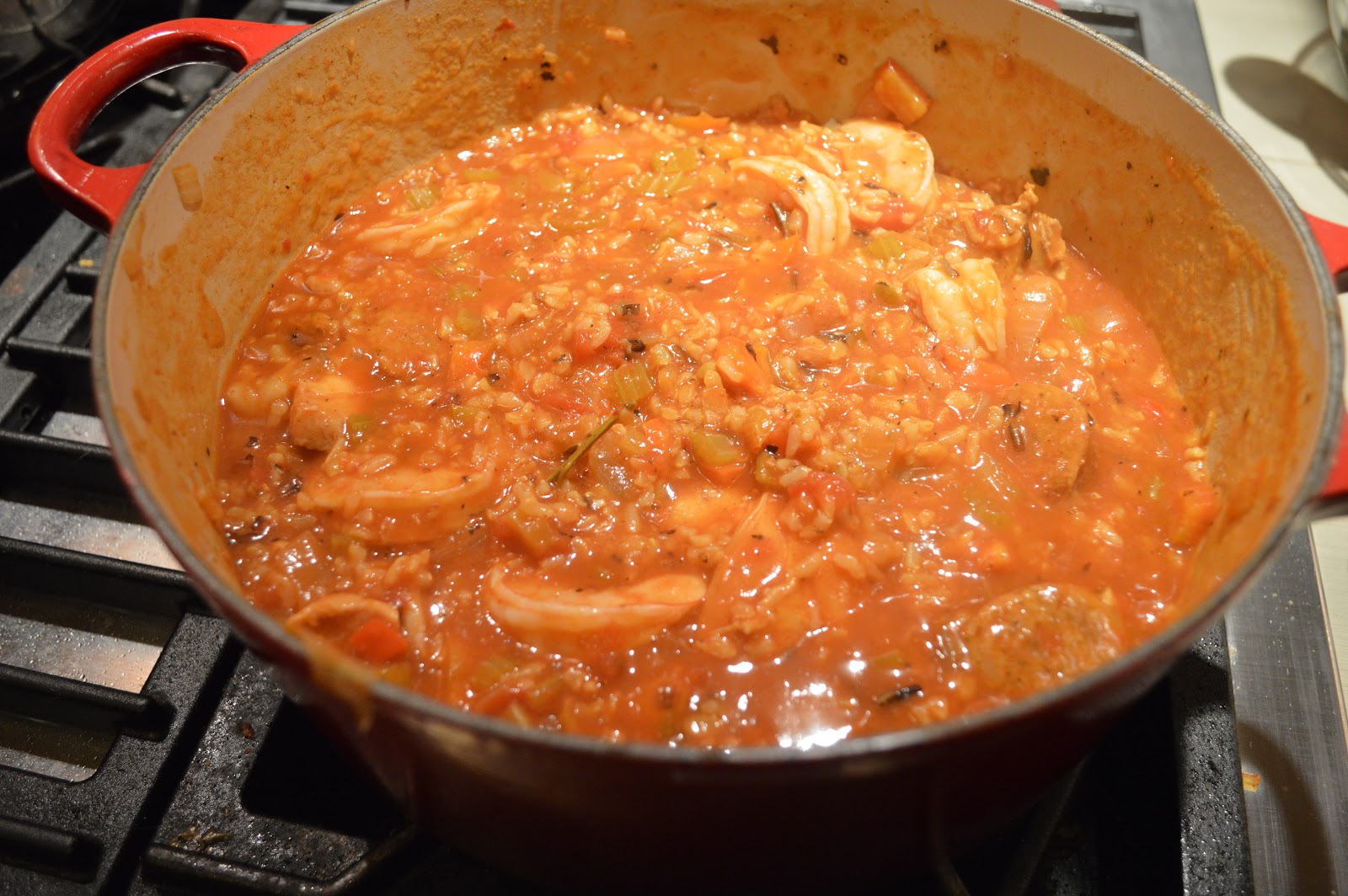


Finally, enjoy, preferably with the people who bring joy to your life. Laissez les bon temps roulez!


Spicy Andouille, Chicken and Shrimp Jambalaya

Serves 6

1 tablespoon extra virgin olive oil
2 links of andouille sausage
3 boneless, skinless chicken thighs
1 onion, diced
3 stalks celery, diced
1 large red bell pepper, diced
2 garlic cloves, minced
1 teaspoons smoked paprika
1/8 - ¼ teaspoon cayenne pepper, depending upon how spicy you want it
1 teaspoon dried oregano
½ teaspoon dried thyme
¼ teaspoon freshly ground black pepper
2 bay leaves
1 ½ cups medium grain brown rice, rinsed well
1 cup beer (like a lager or ale)
2 cups homemade chicken stock or water
1, 14.5 ounce can of whole fire-roasted tomatoes with juice, tomatoes torn in pieces
3 - 4 scallions, sliced
Sea salt, to taste
½ pound fresh shrimp, peeled and deveined

Heat a large Dutch oven or stock pot over medium-high heat.  Add one tablespoon of olive oil and sausage slices.  Cook the sausage until well-browned. Remove sausage from pan and reserve.  Add chicken thighs, in one layer, being sure not to crowd the pan.  Cook until deeply browned on each side.  Remove and add to sausage.  Set aside.

Reduce the heat to medium.  To the pot, add the onion, celery, bell pepper and a little sea salt (about ½ teaspoon), cooking until the onions are translucent, and scraping the bottom of the pan to remove any browned bits from the sausage and chicken.  Add the garlic and cook for another minute or so.  Add the spices (paprika through black pepper).  Cook for several minutes, until the vegetables are completely coated with the spices and it begins to smell toasty.  Add the rice and cook for a few minutes, until rice is also coated with spices.

Add the bay leaf, chicken stock or water and tomatoes. Bring to a boil and then lower to a simmer.  Taste for seasoning, and add more salt if necessary.  Stir in the sausage and chicken.  Cover pot and simmer for about 1 ½ hours, or until the rice is completely cooked through and tender.  Check the liquid after about 40 minutes to make sure it hasn't cooked down too much. If it seems dry, add another half cup to a cup of stock or water.  When rice is fully cooked, add the shrimp and simmer, uncovered, a few minutes or until shrimp are just cooked through.  Remove the sausages and slice into 1 inch pieces, on the diagonal.  Garnish with sliced green onions.


Thursday, September 27, 2012

Vegetarian Muffaletta

A few weeks ago, we celebrated Elie’s birthday with food and music enjoyed with family and friends. 


Elie’s only food request was for an andouille and shrimp jambalaya—he’s been searching for a replica of a dish he ate in Charleston, South Carolina several years ago.  We didn’t even find a comparable version on our trip to New Orleans

We made the jambalaya, and the rest of the menu followed the same New Orleans theme, including a pecan-studded coleslaw, tomato and cucumber salad, cheesy grits and homemade cornbread But one of the crowd favorites was actually the Vegetarian Muffaletta.  I’m sharing that recipe with you.

sunflowers & mason jars...

Carolyn & Elie, chopping veggies for the jambalaya!

Lisa, assembling the muffaletta
I think Elie enjoyed the food—but what he (and I!) really treasured was being able to spend time with people he loves.  It’s a gift we don’t take for granted—having incredible people in our lives we value and respect.

I hope you enjoy this recipe as much as we did—and make it to share with the people you love.


Making the Vegetarian Muffalettta


Vegetarian Muffaletta

Serves 8, as an appetizer

1 loaf ciabatta
1 cup olive salad, recipe follows
½ cup canned artichoke hearts, drained and chopped
2 – 3 roasted red peppers*
4 ounces fontina, sliced thin
4 ounces provolone, sliced thin

Preheat oven to 350 degrees.

Slice the bread in half lengthwise, and remove enough of the inside to make room for the fillings.  Place one layer of fontina on the top half and one layer of provolone on the bottom half.  On top of the provolone, layer the roasted red peppers, artichoke hearts and olive salad.  Place top half on top o f the olive salad.    

Wrap tightly in aluminum foil and bake for 20 – 25 minutes or until bread is warm and cheese is melted.  Slice.  Serve warm and enjoy. 

The Muffaletta can be assembled, wrapped and stored in the refrigerator for up to 24 hours before baking. 

Olive Salad

1 cup pitted Kalamata olives
1 cup large pimiento-stuffed green olives
3 – 4 pepperoncini
2 – 3 tablespoons capers, drained
¼ cup celery, finely c hopped
¼ cup carrots, shredded
1/4 cup extra-virgin olive oil
¼ teaspoon crushed red pepper flakes
¼ teaspoon celery seeds
2 – 3 tablespoons minced fresh flat-leaf parsley

Place Kalamata olives, green olives and pepperoncini in the bowl of a food processor.  Pulse until coarsely chopped.  Pour the mixture into a bowl and stir in remaining ingredients.  Olive salad will keep in the refrigerator, covered, for up to a week.


Tuesday, November 1, 2011

Eating Well in the Big Easy…Local Style

Usually, McKenzie and I are happily connected at the hip, traveling and working together.  But I took the past two weeks to visit with family and friends, ending with five days in New Orleans to spend time with my Dad and explore the city’s rich food culture.

Registered Dietitian warning and disclaimer here:  Rich might be a grand understatement.  When Emeril declared, “Pork fat rules!” New Orleans took him literally.  You’re hard-pressed to find a dish in New Orleans absent from bacon, lardon, guanciale, cracklins, lard, fat back, ham hock or some other form of the little piggy. 

But that didn’t stop me from enjoying every bite.  See 5 Tips for Traveling & Eating Well, below.

My self-appointed mission during my stay in the Big Easy—expand beyond the beignets and café au lait to explore New Orleans restaurants committed to supporting local farmers, fisherman and producers.  I didn’t have to look far, beginning with the restaurant named for NOLA’s favorite animal—the pig. 

Cochon, co-owned by chefs Donald Link and Steven Stryjewski, serves a modern Cajun menu featuring locally source ingredients and humanely-raised meats.  This year, Stryjewski won James Beard Foundation’s Best Chef South If the Louisiana cochon with turnips, cabbage  and cracklins I relished for lunch is any indication, it’s a well-deserved title. 


Owned by the same chefs as Cochon, Herbsaintlocated on St. Charles Street, wins in my book as one of New Orleans’ top restaurants.   Entering the romantic, dimly-lit dining room immediately felt like the perfect antidote to a day of exploring the raucous French Quarter, and the playful French- and Italian-inspired, but distinctively Southern menu did not disappoint. 


Herbsaint nuances the idea of eating local by highlighting the beauty of the ingredients--a mizuna salad with fried black-eyed peas; Louisiana jumbo lump crabmeat over a chilled pumpkin puree; plump Louisiana shrimp tossed with tasso and okra over a crispy grit cake; and a wicked version of pasta carbonara made from housemade spaghetti tossed with guanciale and topped with a panko-breaded and fried poached farm-fresh egg.  I repeat:  Wicked. 


And to top it off, the best dessert I have ever tasted.  Really.  Just listen to this:  Warm chocolate pudding cake served with salted caramel sauce and cashew ice cream, and topped with cocoa nib caramel corn.  It sounds—and tastes—like poetry.  I did share—reluctantly. 


Boucherie, located in the quaint Carollton community, serves creative Southern cuisine.  On a glorious sunny day, after a long walk along Magazine Street, I fell for a lunch of not-so-ordinary corn pudding, paired with a NOLA IPA.  Crispy-crusted savory cornbread filled with fresh corn pudding smothered with okra and drizzled with buttermilk—De-li-cious. 


Celebrity chef and philanthropist John Besh has created a farm-to-table restaurant empire in New Orleans, with a bevy of restaurants and chefs who support and showcase the bounty of Louisiana farms and waters.  After dining at both Dominica and Restaurant August, I posit he and his restaurants live up to the hype.

Dominica, located in the Roosevelt Hotel in the Central Business District, features the rustic, Italian-inspired creations of Chef Alon Shaya, the roasted goat shakshuka notwithstanding.  Settled into the corner of the warm, slightly-swanky dining room, we oohed and ahhed over the chewy, blistered wild mushroom pizza topped with bacon and a farm-fresh egg.  We loved every minute—and every bite.


Where dining at Dominica could be a regular, weekly occasion for locals, Restaurant August doesn’t pretend to be anything other than a place for celebrations and special occasions.  When you enter the historic, mahogany-paneled dining room with its soaring ceilings, it feels special—luxurious. At Restaurant August, we settled in for a three-hour dinner that reads like a seasonal foods playbook—an heirloom beet salad with crabmeat, local bacon and quail eggs; beautiful, meaty local shrimp on merliton; and poussin with a ragu of white beans and wild mushrooms.  The poussin—or young chicken—had been poached and then dipped in a whiskey-spiked batter and fried, with the result being a delicately crispy, tender, airy, unbelievably-light crust surrounding succulent meat.  Really, really, really good.  And yes, we shared dessert—a chocolate napoleon with salted toffee ice cream.   


Lastly, a tour of New Orleans food isn’t complete without a visit to the iconic blue and white Garden District institution, Commander’s Palace Operated by the legendary Brennan Family, Commander’s Palace Chef Tory McPhail elevates old guard New Orleans cuisine by sourcing almost all ingredients within 100 miles and reinterpreting the old classics with a fresh spin.  We had saved the grande dame of New Orleans fine dining for last, and by the time we got to the last day...we were tired of eating.  So instead, we sat in the garden and enjoyed an afternoon drink.  Dad sipped a Sazarac, the traditional Nawlins cocktail made from rye whiskey, and I had a Bellini, made with local beaches soaked in liquor for months and then pureed and topped with sparkling wine. 

It was a very good ending to a very good—and very delicious—week.  I was ready to go home and eat some vegetables—without the pork fat.   
   
5 Tips for Traveling & Eating Well

McKenzie and I are both big believers in exploring a region through its food.  Be it fish tacos or grit cakes, we’re always game to experience the local cuisine.  We have a few quick tips for eating well on the road.     

1.      Be adventurous When you’re traveling, try something new!  Don’t waste a meal on something you can eat at home.  Try the roasted goat shakshuka or the alligator fritters.  Turtle soup?  Of course.  That’s not on the menu in many (any?) Los Angeles or Bellingham restaurants.   

2.      Share We are Registered Dietitians, after all.  While we love to eat, we exercise portion control.  Our rule of thumb—order one appetizer and one entrée or four small plate items per two people.  It’s always enough food.  And the more people you have at the table, the more food you get to taste!

3.      Don’t skip meals Skipping meals always backfires.  You think you’re “saving up” for a great dinner, and then you way overeat—usually beginning with the bread basket—because you’re famished.  Try to snack your way through the day, searching out unique food finds for breakfast and lunch.  Never had a Satsuma?  Have one for a snack.   

4.      Stop when you’re full Listen to your hunger cues.  Hopefully, you’ve taken our advice and snacked throughout the day and are now sharing a wonderful dinner with your friends.  Eat slowly, reminisce about your day, relish in the food you’re sharing with those you love.  Pay attention to when you begin to feel full.  Your body will thank you!  And even better, you’ll feel like eating breakfast the next morning.

5.      Walk. A lot We love to explore a city or region on foot.  Whether it’s pounding the concrete in New York City, walking the boardwalk in Monterey or exploring the trails around Seattle, walking is the best way to see and experience a place.  Even more, it’s good for your heart, your body—and your soul.