Showing posts with label Israel. Show all posts

Tuesday, July 9, 2013

Return to Israel

Elie and I got home a few weeks ago from another trip to Israel, which looks like is going to be an annual adventure.  I love it there.  This year, we took my Mom, Carolyn, who also immediately fell in love with the country, the people, the history, the religious significance.  And of course, you can’t help but fall in love with the food. 

After last year’s trip to Israel, I gave a cooking class at Ciao Thyme, sharing some of my favorite Israeli recipes.  At the beginning of the class, I asked if anyone had been to Israel.  One gentleman raised his hand and said, “I traveled to Israel this year.  I took the blog post you wrote about your last trip, and I went to all the restaurants you recommended.”

Wow! 

So, I thought I’d share a few of the restaurants and sites we discovered on this trip.  Visit here or here for more suggestions.

We spent the first week in Tel Aviv, staying in the Nina Café Suites Hotel, a boutique hotel in my favorite neighborhood, Neve Tzedek.  The quaint, winding streets are lined with small boutiques and cafes, our favorite being Café Dallal, where we went for coffee most mornings.  They happen to have the absolute best ruggelach ever.  And darn good chocolate chip cookies.
 
sign to Cafe Dallal
best ruggelach
None of us could shake the jet lag on this trip, waking between four and five am each morning, the only advantage being we usually got up for an early morning walk on the beach.  I’m sure most people don’t associate Israel with beaches, but Tel Aviv was built from the dessert, on the sands of the Mediterranean Sea.  You can hear all about the fascinating origin of the city at Independence Hall Museum. It only takes about 30 minutes, and can be a good respite from the heat. Make sure to call ahead for times and availability.

The award for best coffee of the trip belongs to Café Sonia Getzel Shapira (also mentioned in my last post for shakshuka—still a good recommendation).   

People born in Israel are referred to as sabras, referring to the cactus fruit that is prickly on the outside, but sweet on the inside.  It’s certainly true, especially when they’re driving any sort of motorized vehicles.  Don’t drive unless you have nerves of steel.  But, Israelis exude a spirit of genuine hospitality and warmth under the sometimes brusque exterior.  And they love to share their love for their country. 

On a tip from a stranger who overheard us looking for a spot for a light lunch, we found the vegetarian-friendly cafe, Meshek Barzilay.  We liked it so much, we went twice, enjoying simple, fresh salads in the lovely outdoor courtyard.
 
lunch at Meshek Barzilay
From Tel Aviv, we took a colorful one hour cab ride to Jerusalem, where we stayed in an apartment rental on Agripas.  The living room window, aside from having a beautiful view toward the Old City, also happened to overlook the courtyard of the home Elie’s grandparents lived in, the home where his Mom grew up.  Elie and his family used to visit every other year, and he had grown up playing in the yard.
 
morning prayer, overlooking the Old City of Jerusalem
Elie’s saba—grandfather—was a butcher in the town’s market, called a shuk.  No trip to Jerusalem is complete without a visit to the Mahane Yehuda Market and the restaurant that honors the market, Machneyuda.  Elie and I had such a fun meal on our last trip, we wanted Mom to have the same experience.  We weren’t disappointed.  The food was even better than the first time, and the raucous environment makes it impossible not to dance in your seat.

beets and squash, stuffed with lamb & a fresh tomato salad in the back

Persian Lamb Stew
By the same owners of Machneyuda, restaurant Mona has a completely different atmosphere—more serene—and a less inventive, but delicious menu.        

I had read that Yotam Ottolenghi—one of my favorite cookbook authors, and a native of Jerusalem—recommended the traditional Middle Eastern lunch spot, Azura, in the Iraqi section of the shuk.  Don’t be put off by a long line out front—it moves quickly.  Azura is known for its kubeh—a vegetable stew with dumplings stuffed with ground meat.

hummus, kubeh and meatball (in back)
Kubeh pairs well with a Gold Star.

Gold Star, Israeli beer
Of course, some of the best meals you can have in Israel are in people’s homes.  Shabbat dinner with Elie’s family featured his Doda Suzie’s bourekas.  On our next visit to Israel, I’m arriving for dinner earlier, so I can learn the recipe.  Stay tuned. 

Shabbat Dinner
Most of our time in Jerusalem was dedicated to visiting the Christian sites in and around the Old City, including a breathtaking panoramic view from the Mount of Olives and the quiet reverence of the Garden of Gethsemane.
 
view from the Mount of Olives

Garden of Gethsemane

While in Jerusalem, we took a day trip to scale Masada and then soak in the healing waters of the Dead Sea.

I think Mom’s favorite moment of the trip was reaching the top of Masada, after climbing the snake path in almost 100 degree heat.

walking up the Snake Path, to the top of Masada
at the top!
We visited the Dead Sea at Ein Gedi Spa Beach, although I would take the description of spa lightly.  Although the facility does offer massages and fish pedicures, the building resembles more of a water park than a luxury spa.  Don’t be put off, however.  A short train ride down to the beach and you can scoop mud from the banks to coat your body in a mud mask and then float in the salty water.  Definitely a check on the life list.
floating, pre-mud bath

We spent our last few days in Israel in the Galilee.  On the way north from Jerusalem, we took a detour toward Moshav Yodfat to visit Goats with the Winds Farm, an organic goat farm that serves a beautiful lunch featuring well-crafted yogurt and fresh and aged cheeses, homemade wine and other foods from the farm.  It was an adventure getting there.  After a dozen u-turns over washed out roads and as many phone calls to the owner, Daliah, we finally found the farm.  Hint:  it’s through the WE ARE FREE sign featuring the Jamaican flag colors. 

It was worth the hassle. 

Lunch at Goats with the Winds rivals any fine dining restaurant—except you’re seated on Turkish carpets under a canopy of trees overlooking the valley below.  Spectacular.   And delicious.


lunch begins with homemade bread and lavender-scented labneh
salads
the dining room
You can also play with the kids.


Be sure to call in advance and make reservations.  I noticed they updated their website with directions since our visit. 

In the Galilee, we stayed at the charming, old world hotel and spa, Mizpe Hayamim.  Perched near Rosh Pina, high in the hills overlooking a spectacular view of the Sea of Galilee, the hotel has an organic farm and gardens, perfect for quietly wandering before parking yourself in a deck chair on the balcony for a nap.

garden path at Mizpe Hayamim
I’ve never met a buffet I liked—until Mizpe Hayamim.  The breakfast and dinner buffets are nothing short of amazing, featuring products grown and produced on the farm.  The cows on the farm are milked first thing in the morning, providing milk for breakfast.  All the cheeses—probably a dozen varieties—are made from their own cow and goat milk.  It’s quite remarkable.

a selection of fresh cheeses, fresh from the farm

a few of at least a dozen salads
Only a short drive from Rosh Pina, the Mount of Beatitudes is one of my favorite places in Israel.  While many sites from the New Testament have been ornately enshrined over the centuries, the Mount of Beatitudes remains tranquil, a place where you can hear the wind.  Mom and I sat in the garden, and read Jesus’s Sermon on the Mount, one of my favorite moments of the trip.  We walked through the grounds, singing old hymns and reflecting.

Mount of Beatitudes
We also walked a piece of the Jesus Trail, a 65 kilometer trail from Capernaum to Nazareth, tracing important sites from the life of Jesus.  We hiked an extension of the trail, winding north from Capernaum and hugging the banks of the Sea of Galilee.

Map of the Jesus Trail, carved on a stone
On our last day in the Galilee, I met with a Druze woman in her home in the village of Maghar to learn to cook authentic foods of the Galilee.  Pnina did not speak English, but her warmth and humor needed no translation, as we cooked for over three hours in her kitchen, making traditional dishes she serves to her own family. 

Mom and Elie dropped me off at Pnina’s house, and I cooked while they went to explore the village of Safed (Sfat).  They returned to have lunch with us, a feast of kebabs cooked in tahini, lentils, stuffed grape leaves and stuffed courgettes (a type of zucchini) cooked in goat yogurt, tomato salad and Elie’s favorite—little yeasted pancakes filled with sweet cheese or walnuts and cinnamon that are fried and then dipped in a simple syrup scented with rose water and lemon.  It’s one of the most delicious things I’ve ever eaten.       

stuffing courgettes
stuffed grape leaves and courgettes


Elie's favorite dessert


family lunch

Pnina, sharing her family photo album
The most amazing part of cooking with Pnina was to experience how she lives, close to her land and in close community with the people in her village.  We cooked with olive oil pressed from pungent green olives from trees she inherited from her parents. The chicken in the kebabs came from her backyard.  She made the goat yogurt and cheese with milk from a neighbor’s goat.  In her cellar, Pnina had shelves of ingredients she had bottled or prepared—za’atar from herbs she had grown and dried, freekeh from wheat she had dried on her roof, bottles of olive oil from her own grove.  We brought home olive oil—secured in plastic Fanta bottles—along with large containers of olives and the fragrant za’atar.

Pnina's za'atar

Pnina's freekeh
I found the experience with Pnina through Galileat, a company that sets up culinary experiences in the Galilee.  Paul Nirens, the owner, met me at Pnina’s and was available to translate. 

It was amazing.  Perhaps if everyone cooked together like that--sharing stories and meals together, despite differences in language, religion and culture--we might achieve peace through food.

The whole trip was amazing, actually, exploring, eating and walking under endless sunny blue skies.  For Mom and me, connecting to our faith.  For Elie, connecting to his mother’s country.  For all of us, spending time with people we love.


Wednesday, August 22, 2012

In Love with the Food of Israel


I’m completely in love with the food of Israel.

What’s not to love about a culture that eats salad for breakfast?  Happily and with gusto, I might add.  It’s a nutritionist’s dream—a country with abundantly available fresh, simply prepared local and seasonal foods.  Good food—food that tastes good and is good for you—is the standard, not the exception. 

Because Israel imports very little food from its neighbors, Israelis truly eat seasonal and locally-grown and produced foods as a rule and a necessity.  Food is reasonably priced, meaning healthy, fresh food is affordable for everyone.  And street food—or fast food—can be healthy, real food, like a freshly blended watermelon juice in summer, pomegranate juice in the fall, or a small bag of nuts or olives from the stands found in every street market.  But perhaps most importantly, there is a spirit of hospitality that pervades the country, where people meet and gather over lengthy meals, spending time together and connecting with each other as they nourish their bodies. 

They’re doing it right.

Here are some recommendations on what and where to eat when you visit Israel.  And you should.

We might as well start at the beginning—with breakfast.  Israelis know how to start their day right—standard fare might be eggs with chopped vegetable salad paired with fresh cheeses and olives, or my favorite—shakshuka, a tomato stew with eggs poached in the sauce.  I ordered it off of every menu.

In Tel Aviv, visit the LovEat cafes for the classic Israeli breakfast, including organic, shade-grown coffee and freshly squeezed juice for only 49 sheqels, which is about $12 US.


breakfast at LovEat

Café Sheleg is a must for good music, great breakfast and a hipster vibe.  At Sonia, sit in the lovely outdoor garden and order shakshuka, served with hearty homemade Moroccan bread.  Or, if you’re feeling chic, head to Hotel Montefiore to dine with beautiful people in the Casablanca-inspired dining room.  Their Tunisian Eggs—a riff on shakshuka—is deeply savory and soul-satisfying. 

breakfast at Cafe Sheleg
the garden courtyard at Sonia
Tunesian Eggs
Did I mention the coffee in Israel is very, very good?  And the café culture is prominent.  More people meet over coffee than cocktails.


Speaking of cocktails, Israel nurtures a burgeoning wine industry.  Definitely sample wines from artisan vineyards including Golan Heights Winery, Pelter and the boutique Galileo (my personal favorite).


If you’re a wine—and food!—lover, escape to the Upper Galilee to visit Pausa Inn.  Owners Einat and Avigdor helped launch the Slow Food movement in northern Israel, and their farm and food reflects their passion. They will feed you (very) well, with breakfasts and dinners featuring foods harvested from their own garden, including olives (and their own incredible, buttery olive oil) and pickled kiwis, and from neighboring farms and vineyards. Einat and Avigdor will also introduce you to outstanding local wines, entertain you with stories of life close to the Lebanese border and encourage you to slow down and relax on the farm.  It’s a lovely place.

breakfast at Pausa
relaxing in the vineyard
first course, fresh from the farm
 While you’re visiting Pausa, have lunch at Focaccia in neighboring She’ar Yeshuv, where we found our favorite eggplant dish—fire roasted eggplant so creamy, it smears on bread like butter.  Served on a bed of lemon-spiked tahini and the best olive oil, it’s crazy good. 

charred eggplant, at Focaccia
Eggplant makes a starring role in Israeli cuisine, as does hummus—the dip of chickpeas, tahini and lemon is a ubiquitous presence in every Israeli home and on most menus.  But the best hummus in Israel can be found deep inside the maze of the Muslim Quarter of the Old City of Jerusalem, at the small, family-owned hummus place.  Walk through Jaffa gate and straight down the Muslim Quarter entrance.  Turn left at the end and it's right there. It has no name.  Swimming in olive oil and topped with herbs and stewed chickpeas, it’s worth getting lost for. 

hummus at Abu Shukri
Hummus is a great example of the delicious, fast and affordable real food options available all over the country.  There are plenty of falafel and shawarma to be found, and half a pita filled with chickpea fritters or sliced lamb accompanied with fresh vegetables, tahini and yogurt can make a fast, satisfying and delicious lunch.

Vanessa's falafel
Snacks most often include fresh or dried fruit, nuts and olives.  To stock up and take some home (which you will want to do!) head to one of the Shuks, or outdoor markets.  Here are some of the ones you shouldn’t miss.

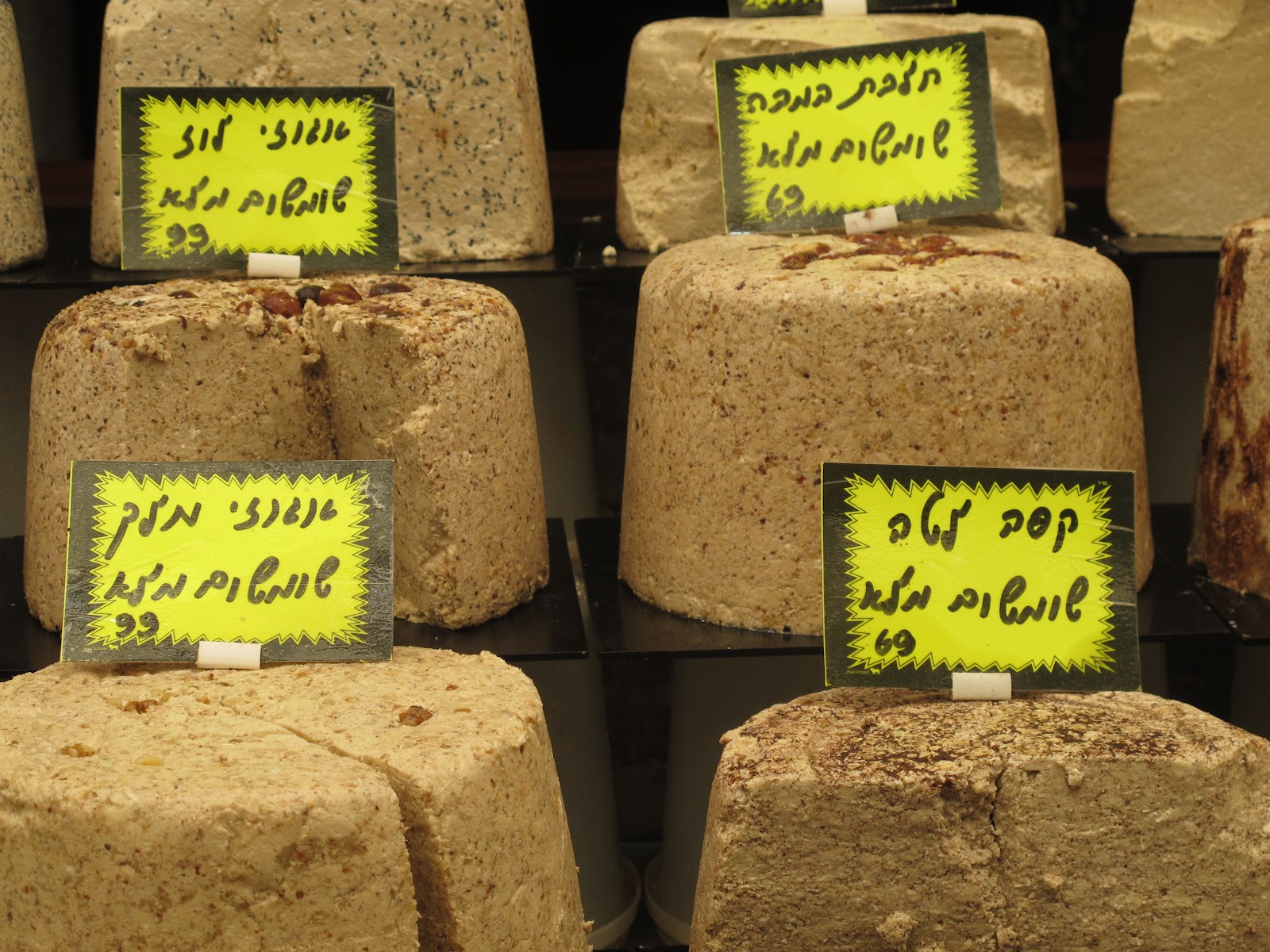
In Jerusalem, shop at the Shuk Mahane Yehuda, where the halva (a sweetened sesame seed paste) from Halva King and flaky burekas (savory pastries filled with cheese, potatoes or spinach) from Marzipan are a must. 


halva
buying burekas
If tasting from the vendors doesn’t satisfy your cravings, have breakfast or lunch at Cafe Mizrachi, which serves gorgeous salads and a very good shakshuka.

shakshuka at Cafe Mizrachi
In Tel Aviv, visit the Shuk Ha'Carmel, a loud and boisterous marketplace selling everything from olives and watermelon to sunglasses and the omnipresent Dead Sea lotion.  Or, head to the port marketplace at the Namal and explore the postcard-perfect shops.

buying halva and pistachios, at the Namal
You can stroll down the streets of Florentin neighborhood and sample the spices, olives, and cheeses at the stands lining the streets.


Or get adventurous and visit Shuk HaTikva, in one of Tel Aviv’s working class neighborhoods, settled by immigrants from countries like Yemen, Iraq, Ethiopia and Russia.  Shopping here proves fresh fruits and vegetables are not elitist. 

watermelon, in season

Iraqi mango sauce
While you’re there, have lunch at the Yemenite diner at the entrance.  Try traditional jahmoun served with tomato puree and a hardboiled egg—or shakshuka, of course, served with flatbread topped with za’atar.  All made more delicious with zhug, a spicy herb sauce.   

shakshuka, with zhug
Here are a few other restaurant recommendations, to help you narrow down your must-taste wish list during your Israeli travels.

Jerusalem

No trip to Jerusalem is complete without a meal at Machneyuda, which gets its name (and much of its ingredients) from the Mahane Yehuda market.  Meals here are fanciful, lively affairs complete with loud music and dancing between tables.  Order the tasting menu and enjoy the scene—Elie and I did.


dancing chefs, at Machneyuda
first of a dozen (or so....) courses

happy

Tel Aviv

Delicatessen 79/81 is the perfect spot for breakfast or lunch—or to stop and pick up picnic provisions to go. Their ready-to-eat counter features amazing flatbreads and a variety of salads perfect for the beach.  Be sure to sample their olive and cheese bread stick (delicious!) or one of their sweet treats.


cheese and cured meat selection, at Delicatessen

picnic on the beach, with flatbread & salads from Delicatessen
For dinner, the list of great restaurants is endless, but this will get you started.  If you’re in the mood for handcrafted pasta or pizzas made from seasonal, local ingredients, meet friends and share plates at Ronimotti.


tomato bruschetta, at Ronimotti

For modern and creative Israeli cuisine, visit HaShulchan on Rothschild Avenue. Sit outside on the patio, have a cocktail and enjoy the Tel Aviv scene as much as the food (which is lovely).

beet salad, with the incredibly creamy Israeli cheese
If you want to feel like a local, try to find off-the-beaten path Joz ve Loz, where you can sit outside in the courtyard and sample the daily menu, created each day from market-fresh ingredients.  One of the friendly servers will gladly help you translate from Hebrew—there is no English menu available.

seasonal salad at Joz ve Loz
Or, try the elevated seasonal creations from Oasis; the bright green walls surrounding the open kitchen create a happy evironment for dinner with friends.  Or sit outside, but don't let the mosquitos bite.

fresh herb salad with duck, at Oasis
Jaffa (Yaffo)

Jaffa, the ancient port city next to Tel Aviv, is home to the Old Man and the Sea, a ‘fish restaurant’ overlooking the Mediterranean, where each table automatically receives over a dozen small plates containing salads, roasted vegetables, hummus, tahini, avocado and other dips and spreads to eat with baskets of charred flatbread.  It’s heaven.  Go hungry.


selection of salads at the Old Man and the Sea
For some of the best breads and pastries in the city, head to the Margoza Café.  And after shopping in the Shuk Ha Pishpishim, have lunch at Puah.  The eclectic restaurant sits in the middle of the flea market, complete with mismatched tables and chairs sitting outside on Persian carpets.  It’s a great neighborhood gathering spot with good food.

shakshuka at Puah
Finally, when in Tel Aviv and Jaffo, you must seek out the paletas—Latin American fresh-fruit popsicles—created by Elie’s beautiful and talented cousin, Nomi.  Her handcrafted and uniquely-flavored paletas are available at numerous cafes and restaurants around the city.  Try the perfectly portioned and not-too-sweet avocado, halva or lemon and poppy seed yogurt. 

There’s so much more about Israel to talk about—rich history, religious sights, gorgeous landscapes and beaches, politics, nightlife.  You’ll just have to join us next time and see it for yourself.

enjoying gelato at Anita